And then there were two…

It’s just my sister and me now. My father died peacefully in his sleep on August 21, 2023. Below is the eulogy I delivered at his funeral service today.


My late father, CMSgt Bob Huff

Writing Mama’s eulogy just six months ago was hard because my mother was part of my heart. To write those words was to admit she was no longer with us. I’m as much my Dad’s son as I was hers and this is tough for similar reasons—and also because you can’t do a man like Bobby Richard Huff justice in just a few hundred words. The poet Walt Whitman wrote of containing multitudes; if there was ever a man in my life who truly contained such multitudes, it was my Dad.

Bobby Richard Huff — Dad — was born in Franklin, Tennessee on June 25, 1936, just one day after his mother Mildred’s birthday. The Huffs — Granny Mildred, Grandpa Ben, Uncle Jackie, and Dad — lived in a tiny tenant farmer’s house on Caldwell Farm. Dad made it clear to me that he both hated and loved the place. In an autobiography he wrote for family, he described his favorite moments in that little house. It’s worth a quote, if only to admire the fact that Daddy had a bit of the poet in him:

“In the summer the heat was awful … The narrow windows were kept open but there was rarely enough breeze to move the curtains. The only relief came during those rare summer storms. The first hope came with the sound of distant thunder. If we were lucky enough to be in its path, the curtains would begin to move. We listened for those first loud drops on that hot metal roof. It would break suddenly with bright flashes of lightning and the roar of rain and thunder. Water poured from the roof and we kept tubs and buckets where we could catch it. The drops would splatter on the screens and send a fine spray over the linoleum floor. The rush of wind would cool that small house before the prop was taken out and the window dropped. That night sleeping would be good.”

Some of my favorite memories are of how my Dad related to his mother. Granny Huff was chatty, smart, sensitive, and sweet, and I think Dad was one of her favorite people to talk to. They had loud, rapid-fire conversations about everything, and they often consisted of Granny declaring an opinion or asking a question and Dad teasing her relentlessly but somehow gently for an hour. And Granny enjoyed every moment.

From them, I learned to love words and conversation and the times when our house was full of people making all manner of noise. When we gathered like that the house was full of joy. That was why when several people came to visit Dad in his final days in hospice, I didn’t ask anyone to speak softly. The conversation flowed, overlapped, grew loud. I believe Dad could hear us, and I believe he loved it. I only wished he could come back to his place as the biggest, most entertaining voice in the room.

Daddy graduated from Antioch High School, the Salutatorian of the class of 1954. However, just as my mother’s class of ’56 yearbook revealed her as “H for most Honest” in the senior alphabet, Dad was — to no one’s surprise — elected most talkative.

He married Margaret Lovene Lane on Dec. 1, 1956. My sister Sherry was born a year later, brother David the following year. Rhonda came later in July 1960, and then after a seven year break, Mama finally had a big-headed carrot top like her husband. That was me.

Daddy had joined the Air National Guard in 1954. He stayed in the service for 41 years, retiring as Chief Master Sergeant — the top noncommissioned officer in his unit — in 1995. Walking through a New York airport for a layover on my flight from Massachusetts to Nashville, the late day light through the windows reminded me of being a boy and running through the grass to meet Dad when he came home from maneuvers each summer. He was often sunburnt and tired, but he’d let loose that big tenor laugh and give me some small souvenir from wherever he’d been. Macadamia nuts and an idol carved from Hawaiian lava rock. Ash from Mt. St. Helens in a jar. Photos of the ocean crashing against Italian coastline, of narrow cobblestone streets in Germany, of haze wrapping the Eiffel Tower in Paris.

Daddy went just about everywhere in the Air Guard and as a civilian. In order of fluency, he spoke Spanish, German, Italian, and some French. And he never stopped exploring languages — in his big upstairs office at the house in Smyrna I had to stop three different CDs he’d left on pause in various players. One was a woman singing German songs, another was a lecture on Roman history, and the third was conversational Spanish phrases. That gives you some idea of how my father’s mind worked.

When I was a kid, Dad would make his time in the Air National Guard sound boring. Once he turned 80 he began telling stories and I learned it was anything but. From secret missions to Central America to riding horses in the Southwest desert to drinking wine in the Azores, Dad found joy in exploring, in learning, in observing. My father had a wild, adventurous side and it didn’t go away after he left the military. He and Mom moved to beautiful Lake Chapala in Mexico for a while, and I think that was as happy as he’d been in years. They moved back to the states after my brother passed, but Dad remained restless till the end — because a mind like Bob Huff’s was never content with sitting still, and that was one of the many things I loved about him. We were very alike that way.

Sorting through memories to share with you has been an impossible task. Some are too much about me, not enough about Dad. Others are too complicated to communicate with ease. I did think of one that seemed right because it revealed a side to my father he didn’t let many people see.

Dad and I went on a fishing trip with his friend James and James’s son Kelly when I was 15. I was put out, thinking I was too old — Kelly was younger than me, still a little kid — and also, hey, I was a teenager, you know how they can be. But Dad and James immediately surprised me by going to a store near the lake and buying nothing but junk food. We stayed in a cabin, and seeing how relaxed my father was with his friend, how at ease, making silly jokes, poking fun at James and James giving good as he got — it all made me realize for the first time that once he’d been a kid like me. Dad and his friend only got annoyed with us, their sons, one time — when we both caught fish and they didn’t catch a thing.

The best moment of the trip, though, was when we took the boat out at night to see if we could get any bites. It was a full moon and with his sharp eyes Dad navigated easily. We anchored in a cove surrounded by high, tree-lined cliffs, and dropped our lines in the water. After a while, I noticed that Dad had fallen silent. Then I did too, as did James and Kelly. And we sat there quietly in the cool summer night, just watching fireflies flicker in the trees above and listening to the water hush itself against the limestone walls around us. At some point, I realized that my loud, loquacious father was simply letting himself enjoy the silence. It was like that perfectly still moment that sometimes falls after a congregation has prayed aloud in church. In that instance I knew I’d never fully understood the depths of my father’s personality, just what a truly complex, brilliant, wonderful man he was.

Dad’s command of words was formidable, but he knew that living, like music, is made of silence as well as sound. He knew that sometimes you just let go of words and listened to the world breathe around you.

At this point I already feel like Dad would say I’ve gone on too long. After all, after my fourth child Dylan was born in 2003, Dad greeted me on the phone with a hearty, “Congratulations! You can stop now.”

Mom and Dad lost two of their four children. My brother David died in 2000, and my eldest sister Sherry died in 2016. I was worried both deaths would break them, but I should’ve given my parents more credit. And Dad surprised me again after Sherry passed. It was storming when she died. Just after the storm moved on, Dad said he stepped outside and for the first time in his life, saw the actual end, the termination point of a rainbow. In telling the story I always heard a little wonder in his voice.

A few days later, my family’s dear friends Silvia and Nacho brought Dad a cedar sapling. They showed him where they’d found it, and it was the exact place where he’d seen the rainbow end. So they planted the tree in one corner of the back yard as a memorial to my sister. Even though in life my father could very much seem like a practical, no-nonsense military man, he held strong spiritual beliefs and never stopped studying mythology, history, philosophy, and scriptures from various religions. Even after Bob Huff had trouble walking without assistance, he was ready for an adventure, if only in his kaleidoscopic mind.

I’ve read that seeing deer after the death of a loved one could be a sign “that our loved ones remain connected to us in spirit, even though they are no longer physically present.”

My father died at 2 am on the 21st. I stayed with him for a while, told him I loved him, that I would take care of my sister. Then I drove back to his house in Smyrna.

As I passed Stonecrest TriStar Medical Center, where my sister died and where Dad first went when he got sick the final time, I saw motion out of the corner of my eye. I glanced to the right and saw a young stag running through the grass beside the road. Mindful of the danger of hitting a deer — to the deer and to me — I slowed to about 10 mph. Sure enough, it bounded into the road, flashing through my headlights for a moment, then it leaped into the field on the other side. It was 3 in the morning, and I simply stopped the car on the empty road and watched it race away into the dark.

For a moment I felt real wonder cut through the lead-like grief sitting heavy on my heart.

The truth is that it was the coolest part of the day and the young male was taking advantage of it to seek out food and water. Yet I couldn’t help but feel it was also a message.

My father is gone, but his wild, wandering spirit will always be out there somewhere, looking for another adventure. Looking for more wonderful, colorful stories to tell.

Of Memories and Plane Crashes

The memory is clear. A wet day, overcast, still more winter than spring in Nashville. We pile in the car–Mom’s orange-red VW Beetle, possibly the white VW microbus, that part isn’t as clear or important–and drive to Donelson Plaza.

Northwest up Murfreesboro Pike, right on Donelson Pike, follow that till it bottoms out, turn left, take the fork, drive up Old Lebanon Road. There was a Woolworth’s Drug Store and Dinette there. And Cain Sloan Department Store… or, if I’m being true to my child’s memory, it could’ve been Castner Knott’s. Four-year-olds don’t always notice things like that.

It is there, in an empty lot by the Plaza, that we see the plane. It’s battered and twisted and there is a temporary fence around it. There is at least one TV crew there, with a huge camera. There is a crowd.

What burns in my mind is the crumpled tin can body of the plane. I think, people died here.

The plane seems huge.

If memories are imprinted on a long reel of film, the frames around this moment are ghosted, too whited out by age and time to see. But I remember this broken plane and the destruction around it.

Or I thought I did. At some point I started telling myself I made it up. I cobbled together news footage and childhood fears and maybe some vivid dreams and came up with this memory.

planecrash72Then today, I found it. I’d remembered a real event, after all.

I discovered the plane had been carrying four men, and it had gone down, according to my father, on Todd’s Knob, a hill by Donelson Plaza. Dad’s memory for such events is striking in general and makes sense, especially here–he worked for the Nashville Airport Authority at the time.

Dad thinks we saw the wreckage well after it happened but before it had been moved by the authorities and that rings true. There were many people there, just gawking–and I remember that, too, because even though I was only 4, I took in all the other people there and something about them scared me.

We were staring at a nightmare, a tomb.

Speaking on the phone with Dad, he segues into his own childhood story of a plane crash he witnessed near the end of World War II. He was 9.

Jackie (my uncle, Dad’s older brother) and I were laying in the yard, watching fighter planes maneuver. Pretend dog fight.

Dad’s family lived near a plant built late in the war to churn out new fighters that would be sent overseas.

They collided, exploded. We ran to the field where they fell.

There were small squares of aluminum hot and burning the grass. Bits of parachute fabric fluttering on blackberry bushes at the fence line. People–kids, locals, farm folks, sharecropper families–were crowding in.

The military hadn’t closed off the area quickly enough. My grandfather, Dad tells me, made it home from work. But when they got in the car to go back out to the grocery, they were turned back. The road was closed.

Dad is stuck on one detail. It is his own moment of nightmare. Of staring at a tomb.

One girl found a finger.

That girl who found a finger, she carried it around for weeks, showed it at school.

[Newspapers.com]

Fishing Trip

(I have written about what’s going on with my father here. I wasn’t sure why I wrote the post below and still am not sure, but it is what it is.)

We rode up through the mountains and then through the forests to the lake. James’s son Kelly and I sat in the back of James’s El Camino. You and James sat up front driving and talking about whatever men talk about with wind bellowing in the windows and country music blaring through the speakers.

The lake revealed itself curve by curve, glimmering through the trees. A burst of reflected sunlight here, there a gray green slice of waves.

Then we were at the main lodge to check in. Kelly and I walked idly around the lobby, picking at brochures. I’d just begun driving. Kelly was 12. We’d played off and on for years when you and mom got together with James and Linda but I felt like I was saddled with amusing this kid. I wasn’t very good at it. I was 16. Too old for this.

You flirted with the older round women behind the check-in desk and I watched a master work. Your pale green eyes and devil’s smile. Both women giggled and nodded and seeing them so charmed I realized how much I didn’t know about my father.

Shopping at the convenience store on the state highway before we arrived, you’d bought nothing but garbage junk food and I thought, this is how men eat when no one is around to frown at them. 

We loaded into the cabin, you and James on one side, Kelly and I on the other. I stared at the lake through the windows. Beyond the rolling water, the rock faces rising to the trees. But for you and James and your beer-fueled laughter, it was the quietest place I’d been in a while.

Before we headed out with our rods and tackles we ate Ho-Hos and Twinkies and RC Cola, and you didn’t say a word about how fat I’d been as a boy or about worrying I might get there again and I loved you for it.

Under the white sun we floated and for a son whose father is a legendary talker it is perhaps remarkable that I remember nothing of any of our conversation. I know with our red hair and pale skins we burned. We burned, and we didn’t catch any fish.

Time has shuffled memory’s deck of cards–blown it apart and lost a few, really–and I can’t quite recall the order of the rest of our trip. So here is what I do remember:

  • We docked to gas up the boat and buy a few supplies and Kelly and I wandered the dock. It was like an outpost in another country. I couldn’t see any roads on the land around it. It was as if the smell of the entire lake had been concentrated there.
  • At some point I examined the fishing license you’d gotten me. My birthday was 2 years and 2 days off–11/5/1965. I never knew if you’d made me older on purpose, some game law, but I never asked you, either.
  • Neither you nor James ever caught a fish. Kelly and I caught 3 a piece. You wanted to show me how to clean and filet them and I watched, but I couldn’t do it. I could never do those sorts of things. By the time I was 16, I felt like you’d finally come to a truce with that. You and James fried the fish and we all ate and it was better than I thought it would be.

The thing I remember most clearly was how we took the boat out at night.

It was cool for a Tennessee summer. We dropped the fishing lines in the water where they drifted unbitten.

Eventually we fell silent.

I was 16. Kelly, at 12, was just the right age for fishing trips with Dad. Me, I was too old, too easily bored for this.

Yet I remember sitting silent in that boat at night on a quiet lake better than anything.

I was never going to be too old to drift there and watch the stars with my father.


This space

I may renew an effort to update this thing daily for a while, just to see if I can. In part because my father’s fight against cancer is so heavy on my mind (because I live 1000 miles from my parents so I’m obsessed with my inability to help them) I find I have a need to write more often. Not about cancer. Not necessarily about whatever is going on in my head regarding my father and my relationship with him and how that has formed me. Mostly just to write and make a record of whatever.

Perhaps this counts as one of my parodies of the blogger apology for not updating more often. Which is fine. Hey guys.

Daddy

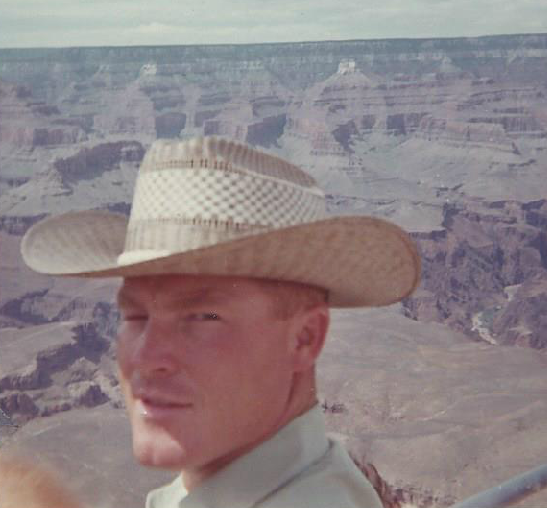
dadgrandcanyon
My father, Bob Huff, at the Grand Canyon in 1968. Pretty sure this was a selfie.

He always wanted me to be tougher than I am. Physically tough. Not the fat, bookish boy I was, but lean and as strong as my shoulders–inherited from him–implied I could be.

More than that, I knew he wanted me to be mentally tough. Not so quick to emotion, not so easy with tears. He wanted at least one of his sons to learn to be cool in an emergency, level-headed, in charge. He wanted this so once I wasn’t under his roof anymore, he wouldn’t feel the need to worry about me. I know he always has, even though after I turned 18, he rarely said a word.

I’ve tried. I’m in okay shape for a 47-year-old man born and raised in the south, eating southern cooking most of my life. I lost 100 pounds between age 43 and now and kept it off and most days feel better physically than not. I’m still prone to severe bouts of depression, but at some point in adulthood I discovered there were times I was great in an emergency. I could maintain my cool and save the freakout for later–a pretty handy skill to have. At some point I also discovered I could survive the bouts of the blues. It took getting help and patiently riding out internal storms, but the clouds have usually lifted, eventually.

And I’ve been thinking about this a lot because both my family and I–I think–fear my capacity for falling apart. Or just being useless. I did the best I could to be strong for my parents when my brother committed suicide, and I may have done better than I thought I did, but I still felt like my sister Sherry shouldered the greater burden. My personal life was chaotic at the time, so I came home to Nashville for my brother’s funeral already heavily burdened with all sorts of bullshit. My internal load was creaking, and my brother’s death almost cracked the undercarriage.

Then about a year later Dad had a stroke, and I did what I could then, too. But it didn’t feel like enough.

Now I’m at a place in my head where I feel like I could help my parents. Be strong for them, and for my sisters. I can’t explain it without going into a lot of bullshit that would be more personal than this already is–I tend to blog about news stuff or history because “personal” blogging makes me uncomfortable–but if I lived close to my family, I think I could help take some of the burden away while Dad copes with his cancer.

Since 2012, I’ve lived over 1000 miles away. A big change from before, when I rarely lived more than a 3-4 hour drive from any close relative.

And I love living here. I have a Tennessee twang and get sentimental about my hometown, Nashville, but something in my temperament was always meant to live in New England. I suspect that part of me is a lot like my father, who had an implied attachment to this region for as long as I could remember. He hated living all his life in the south.

But it’s very far from my folks, from my sisters. And learning that Dad’s cancer wasn’t gone, that he would need radiation, well, it made the distance stretch. I am distracted lately because my brain is trying to ford the distance and find ways to bridge it. To do something. Anything.

My father was never an actual cowboy. The photo above was made at the Grand Canyon in 1968, on a trip out west to see his uncles. He was always a working man and a part-time military man in the National Guard. He was also cool if things felt crazy. His level voice from the front yard as a tornado approached, then waiting to watch it come, until the last moment. Taking groceries to my brother who was in the throes of a psychotic, manic episode as if that was natural. Striding through the hospital cafeteria the morning after my first child was born 2 months premature, solid and energetic as ever, good old Dad–I’d never been more happy to see him and though I was 27, I kept holding his hand like I was 6 again.

My father has always wanted me to be tougher than I am. Now, more than ever, I’m going to try.

Fuck Cancer, Part 1, probably

Not long ago my father Bob, who is 78, had surgery for bladder cancer. Turns out he still has cancer. He will soon undergo radiation treatment, most likely at Vanderbilt. Good thoughts from anyone who reads this are greatly appreciated. I don’t know if I believe in prayer, but I do believe in collective good will. My old man could use some.